


How AirEvo’s Fridge Deodorizer Works: CH-CUT and Passive Airflow
Opening the fridge to a mixture of seafood, onion, garlic and leftover-food odors is a familiar frustration in many homes. Traditional air fresheners simply cover these smells with fragrance, while ordinary activated carbon sachets become saturated and stop working after a month or two. The AirEvo fridge deodorizer needs no electricity, added fragrance or frequent consumable replacements. How can a small, perforated food-grade stainless steel box noticeably reduce odors within 24 hours and have a design life of up to 10 years?
Related Products
 Featured Picks
AirEvo Fridge Odor Eliminator | 1–4 Packs
- 24/7 odor control, bacteria removal and air purification
- Designed for up to 10 years with no refills
- No batteries, fragrance or routine maintenance
- Food-Grade SUS 304 Steel
- UPS, FedEx or 4PX delivery · Tracking after dispatch
- Secure PayPal Payments & Buyer Protection
- 90-Day Satisfaction & Money-Back Guarantee
- Customer Support Before & After Purchase
1. The core technology: From physical odor storage to CH-CUT nanocatalytic decomposition
To understand how a fridge deodorizer works, first distinguish between three fundamentally different approaches to odor control: odor masking, physical adsorption and catalytic decomposition.
Putting pomelo peel, lemon slices or solid air fresheners in the fridge simply masks odors with a stronger, volatile fragrance. The original fishy or foul-smelling molecules remain in the air and can even transfer to ice, cream and breast milk. Traditional bamboo charcoal sachets, activated carbon and baking soda instead rely on physical adsorption: like a sponge, their internal micropores temporarily store odor molecules. Once those pores are full, charcoal sachets stop capturing odors and may release the stored smells back into the fridge when temperatures fluctuate.
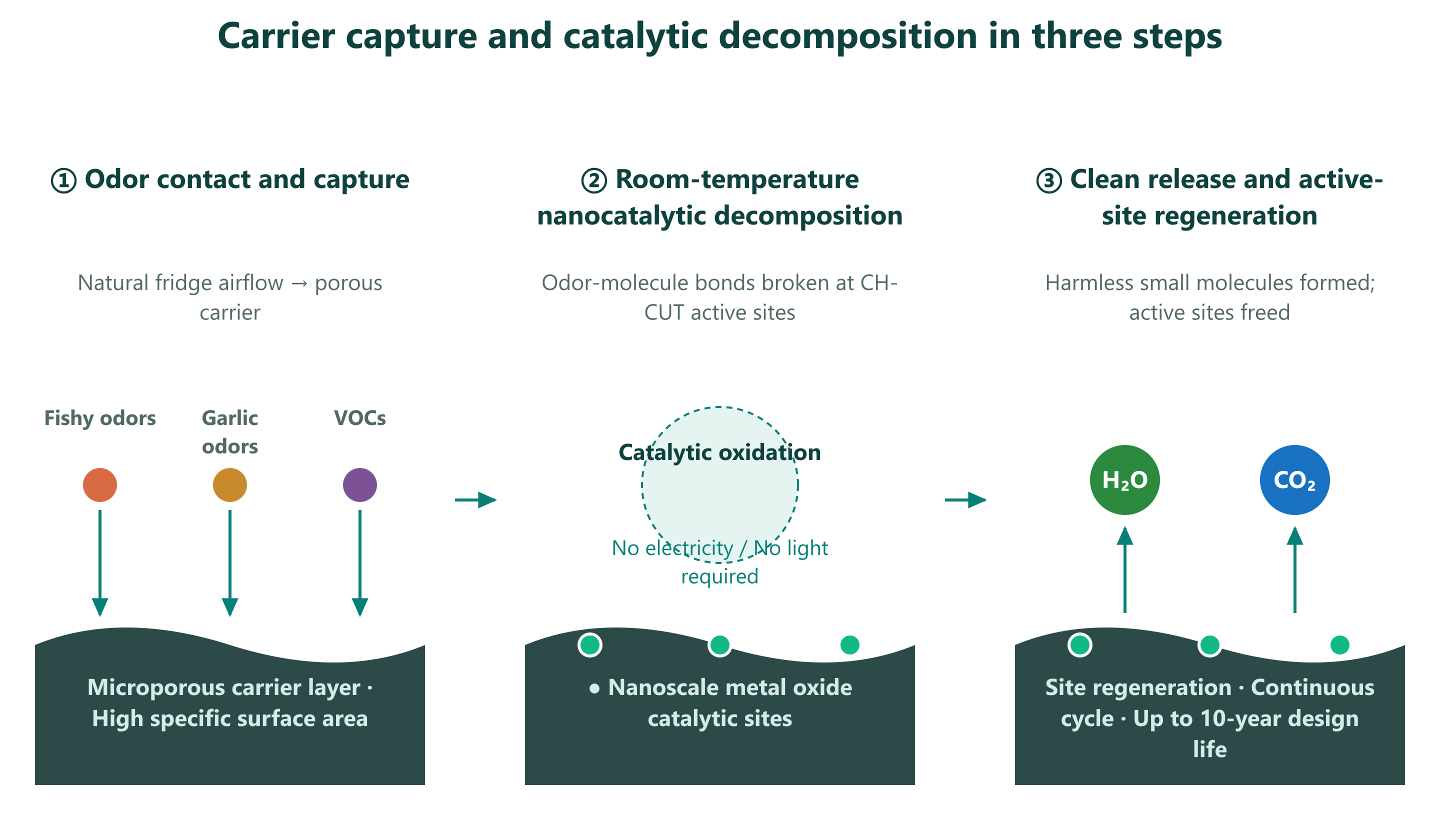
The AirEvo deodorizer does not simply trap and store odors inside a box. Instead, it combines “porous-carrier capture + nanoscale metal oxide catalytic decomposition (the CH-CUT approach)” in a coordinated, dual-action process that directly converts captured odor molecules into harmless substances at room temperature.
Microporous carrier: Capturing airborne odor molecules first
Fishy smells (trimethylamine), odors from spoiling meat (hydrogen sulfide and thiols), fruit- and vegetable-ripening gases (ethylene), and sour, spoiled-food smells from leftovers (volatile organic compounds, or VOCs) all come from small gas molecules moving freely through the air. The core's porous carrier provides a large specific surface area, rapidly capturing and concentrating these odor molecules at the material's interface as air passes through (see the International Union of Pure and Applied Chemistry (IUPAC) definition of interfacial adsorption).
Nanocatalytic sites: Breaking chemical bonds to form water and carbon dioxide
The carrier surface is evenly loaded with nanoscale transition-metal oxide catalytic active sites (for related composite-catalyst preparation methods, see published patent CN110721579A and CN206449754U for the CH-CUT approach). Once captured odor molecules contact the active sites, catalytic oxidation can take place at room temperature, breaking their chemical bonds and converting them into trace amounts of odorless small molecules such as water (H2O) and carbon dioxide (CO2).
Why can the core last up to 10 years without replacement? The answer lies in catalysis. According to the chemical definition of a catalytic reaction, the catalyst itself is not consumed during the reaction. Once attached odor molecules have been broken down and leave the surface, the core's active sites become available again to capture the next batch. This dynamic cycle of “capture, decomposition and active-site regeneration” solves the familiar problem with traditional charcoal sachets: they quickly become saturated and need replacing every 2–3 months.
2. How the system works: Round-the-clock air purification without power or a fan
When people first see the AirEvo fridge deodorizer, many wonder: How can it remove odors throughout the fridge without a plug or a built-in fan?
The air in fridges and other everyday enclosed spaces is not completely still. Air circulation through the fridge's cooling ducts, natural convection caused by temperature differences, air movement each time the door opens or closes, and the Brownian diffusion of gas molecules all keep air moving. AirEvo makes use of this passive natural airflow to maintain continuous odor removal in a three-step cycle:
Step 1: Natural airflow enters through 360° ventilation holes
Closely spaced ventilation holes around the sides and across the top allow odor-carrying air to enter the stainless steel housing from any direction.
Step 2: The CH-CUT core catalytically breaks down odors at the source
As air passes through the nanocatalytic core, odor molecules responsible for fishy, garlic and musty smells, along with airborne bacteria and mold spores, are captured and undergo catalytic decomposition.
Step 3: Clean air returns to the enclosed space
After decomposition, fresh, odor-free air naturally flows back out of the box. This cycle runs continuously, day and night, 24 hours a day, helping food in the fridge retain its original fresh aroma.
Precision-engineered five-layer modular structure and food-grade SUS 304 stainless steel housing
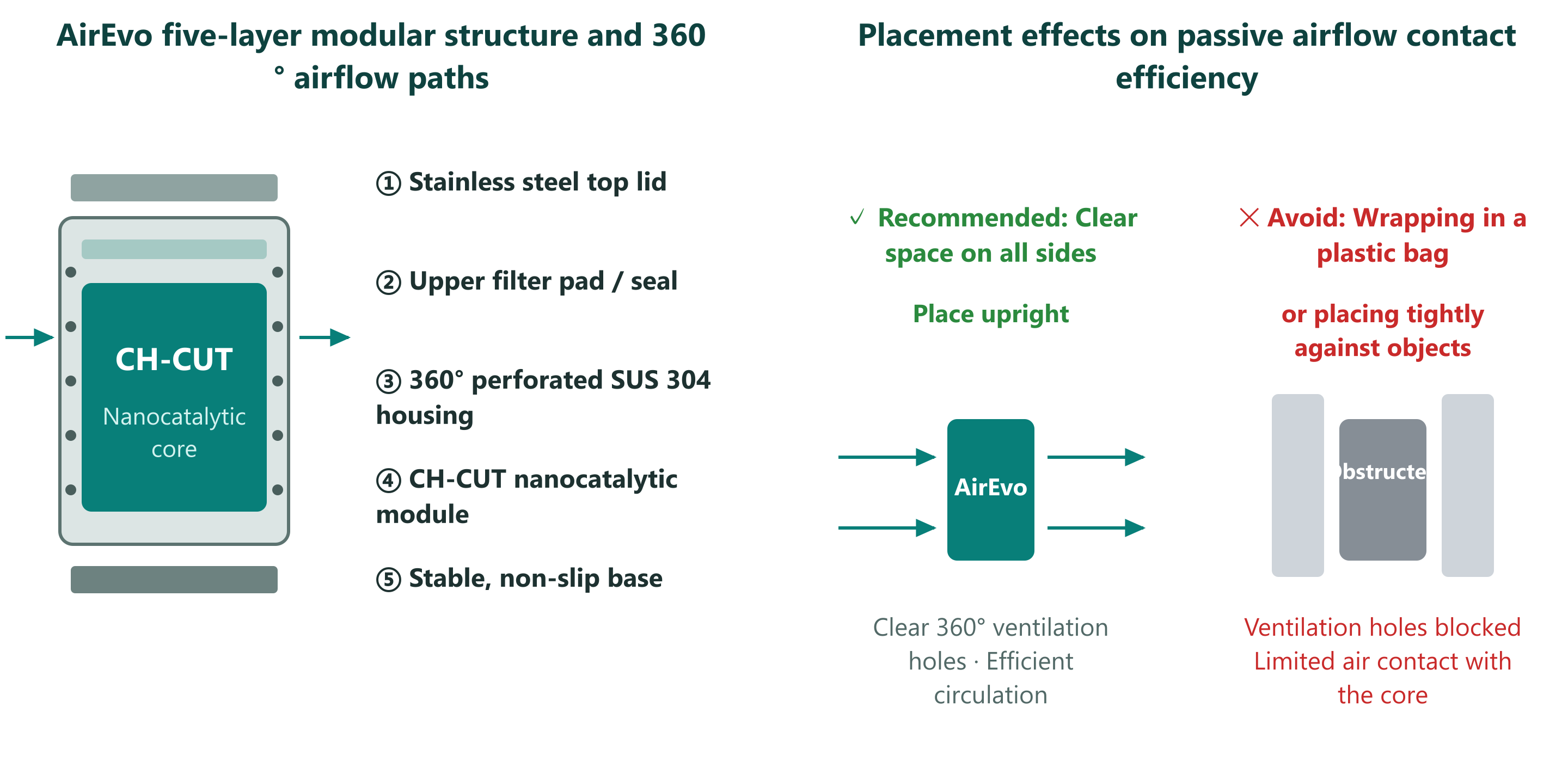
To support a design life of up to 10 years in the fridge's cold, humid environment, where knocks are common, AirEvo avoids plastic housings that can become brittle with age and nonwoven pouches that can get damp and tear. Instead, it uses a compact, five-layer modular design (from outside to inside: top steel lid, 360° perforated stainless steel housing, upper filter pad and seals, CH-CUT nanocatalytic core module, and stable base):
- Why use a 360° ring of ventilation holes? For a passive deodorizer, odor-removal efficiency depends directly on the effective contact area between the air and the core. Openings on all sides greatly reduce airflow resistance, allowing air to enter from multiple directions and circulate freely without having to point the unit toward a vent.
- Why choose food-grade SUS 304 stainless steel? Fridges are cold, humid spaces where food is stored. Food-grade SUS 304 stainless steel offers excellent corrosion resistance, low-temperature performance, rust resistance and impact resistance. It withstands splashes of fruit and vegetable juices and can be placed confidently beside fresh food.
- A clear safety distinction: Solid-phase catalysis without actively releasing ozone. Some powered electronic deodorizers disinfect and remove odors by releasing high concentrations of ozone (O3), but the US Environmental Protection Agency (EPA) assessment of indoor ozone generators has long made clear that excessive ozone can irritate the respiratory tract and accelerate the oxidation of some foods. AirEvo relies solely on physical processes and solid-phase catalysis, with zero power consumption, zero ozone release and no added chemical fragrances, making it fully suitable for use around mothers, babies, pets and fresh food.
3. Why choose AirEvo? Four popular odor-removal methods compared
Using the official AirEvo technology and product features guide, we compare the AirEvo nanocatalytic deodorizer with three common fridge odor-removal methods so you can see the product's advantages at a glance:
| Comparison criteria | AirEvo nanocatalytic deodorizer | Traditional activated carbon sachets / baking soda | Air fresheners / fragrance-based odor maskers | Plug-in / rechargeable electronic ozone generators |
|---|---|---|---|---|
| Core odor-removal mechanism | CH-CUT room-temperature catalytic decomposition (conversion at the source) | Physical adsorption in micropores (temporary storage only) | Release synthetic fragrances to mask odors | Use electricity to generate ozone or negative ions for oxidation |
| Speed and duration of results | Noticeable results within 24 hours; continuous decomposition, 24/7 | Initially effective; saturated within 1–3 months | Fragrance mixes with odors; stops working once the fragrance evaporates | Intermittent operation, limited by battery charge and airflow paths |
| Service life and consumables | Design life of up to 10 years; no consumables to replace | Must be repurchased and replaced every quarter; high long-term cost | Disposable consumables requiring frequent repurchases | Batteries are prone to reduced performance in the cold and need frequent charging |
| Power and maintenance needs | Zero power consumption (passive airflow; ready to use after unpacking) | Zero power consumption, but requires regular sun-drying or replacement | Zero power consumption | Must be regularly removed from the fridge for charging; cumbersome to use |
| Materials and food safety | Food-grade SUS 304 stainless steel; fragrance-free and non-toxic | Nonwoven pouches can get damp and tear, spilling charcoal dust | Contains volatile fragrances that can transfer odors to ice and food | Excessive ozone concentrations may irritate the respiratory tract or accelerate food oxidation |
| After-sales support | Official 90-day satisfaction and refund guarantee | Consumables are generally not eligible for returns or exchanges once opened | Consumables cannot be returned or exchanged once opened | Electronic components are prone to moisture-related faults in cold, humid conditions |
4. Beyond the fridge: Six odor-prone settings and a guide to proper use
With its compact metal housing and electricity-free design, the AirEvo deodorizer can be used in both fridge and freezer compartments, as well as other everyday enclosed spaces where odors tend to build up:
4 practical tips for placement and everyday care
- Ready to use after unpacking; keep the 360° ventilation holes clear: Before first use, remove all outer protective film and place the deodorizer upright in an open area on a fridge shelf or inside a cabinet. Do not cover it tightly with plastic bags, food-storage containers or other items. One unit is recommended for each separate temperature zone or compartment.
- Do not block the fridge's own air vents: Place AirEvo on a shelf where air can flow past it. There is no need to position it right against the cold-air outlet on the back wall, let alone block it, as this can interfere with normal cooling circulation.
- Combine it with sealed food storage and basic hygiene for easier odor control: The deodorizer breaks down odor molecules that spread into the air. Clean up spoiled food and soup spills on shelves promptly, and store cut onions and seafood in sealed containers. This reduces new odors at the source and makes odor removal more effective.
- No routine disassembly or washing; simply wipe the housing if dirty: The AirEvo core does not need to be washed with water, and you should never dry it in strong sunlight or bake it as you might an ordinary charcoal sachet. If the stainless steel housing gets greasy or dusty, wipe the surface with a slightly damp, soft cloth and let it air-dry completely before putting it back. Never immerse the whole unit in water, put it in a dishwasher or disassemble the housing yourself.
5. Frequently asked questions about the AirEvo deodorizer
Yes, but what matters is the material inside the core, not just the metal housing. Ordinary bamboo charcoal sachets only store odors in physical micropores. They become saturated within 1–3 months and can even release odors again when temperatures rise. The AirEvo deodorizer contains a CH-CUT nanocatalytic core inside a SUS 304 stainless steel housing with 360° ventilation holes. It not only captures odor molecules but also catalytically decomposes them at room temperature into trace amounts of water and carbon dioxide. Within 24 hours of being placed in the fridge, it can noticeably reduce the mixture of fishy, garlic, onion and leftover-food odors.
Air inside the fridge is not still. Cooling-duct circulation, natural convection driven by temperature differences, air movement whenever the door opens or closes, and the Brownian motion of gas molecules all keep it circulating. AirEvo uses 360° ventilation holes to greatly reduce airflow resistance, allowing passive natural airflow to carry odor-laden air continuously through the catalytic core for decomposition.
Because catalytic decomposition does not consume the catalyst itself. Once odor molecules attached to the catalytic sites break down into harmless small molecules and leave the surface, the active sites become available and active again, ready to treat incoming odor molecules. Combined with the corrosion- and rust-resistant food-grade SUS 304 stainless steel housing, this gives the unit a design life of up to 10 years, with no consumables to replace during that time.
Yes, it can go in the freezer, and no sun-drying is needed. AirEvo contains no batteries or electronic components, and its SUS 304 stainless steel housing withstands low temperatures, so it can effectively prevent ice from picking up unwanted odors in the freezer. Unlike ordinary charcoal sachets, it does not need to be sun-dried or have its core washed with water during routine use; simply keep the ventilation holes clear. For multipack offers and details of the 90-day refund guarantee, visit the official AirEvo website.